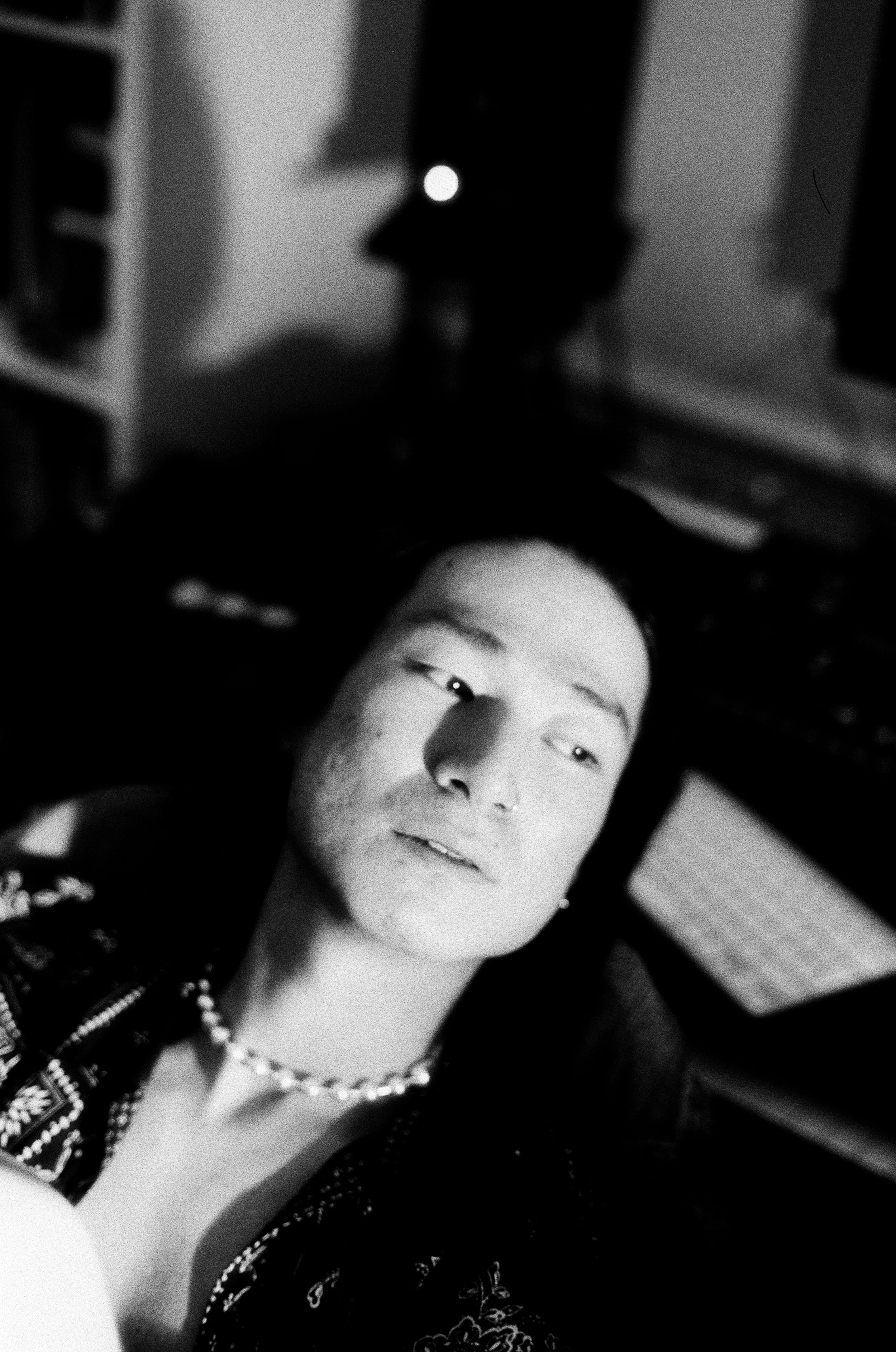
Entities is the name of a project I carried out to empower a few friends who live their lives to the fullest. It is based on the concept of difference: its aim is to permanently record the striking beauty of my trans and non-binary friends, who continually struggle with themselves—and with the world around them. Their resilience and capacity to overcome immense obstacles, such as rejection and discrimination, are truly worth documenting. Few people I know demonstrate such unwavering determination to thrive amid life's most challenging circumstances.
Photography, by permanently preserving one's appearance, is often regarded as being about death or what no longer exists. On this occasion, I couldn't disagree more with that notion: while it is true that photography functions as a relic of the past, it is equally true that when used to capture one's beautiful presence, the emphasis lies in the joy and celebration of that very moment—not in the relentless passage of time. Hence the inadequateness of Barthes' claim.


I chose the word Entities because all the subject of this research have a distinct and independent existence, often expressed through the way they look. Indeed, celebrating with photographs their beauty is also a way of documenting a flourishing minority that uses the concept of construction to their advantage. The degree of artifice experienced in our lives is unprecedented and, like many other aspects of our existence, gender has also been hugely impacted by what is constructed.
Major metropolises are no longer spaces that support the traditional family. A great number of people live there in solitude or in shared flats with strangers, as a single small room is often all they can afford. Many of those without a traditional family structure behind them struggle to find happiness; it seems that love remains a domain almost entirely governed by patriarchy and matriarchy. The ignominy of such a social imposition is as colossal as the forms of discrimination that are routinely witnessed yet swept under the carpet by perfect mothers and perfect fathers—obviously, for the sake of their own peace of mind.
Ultimately, this project is grounded in the principle of disinterestedness: it was undertaken solely to celebrate the remarkable beauty of my friends' appearances, and for no other reason. Though this ideal of selfless action emerged within medieval Christian teachings, it is striking that it can now be meaningfully applied to a group of people who, in that same era, would have been burned at the stake for supposedly devilish conduct.


An erudite man once said that there is a divine spark in everyone of us and, wenty-one centuries later, this spark is often acknowledged as stardom. These creatures, with their way of living and style, are stars in the urban nebula where everything is decided a priori so to respect social, political, economic, academic and sexual structures. Current socio-political circumstances do not like people that shine of inner light: they should be absorbing the one emitted from the predominant pole of power and be thankful for it.
“Everyone in their right place” remains the golden rule of mechanized societies. Yet to exist beyond the binary division of biological reality does not mean that all Entities transgress law, religion, or morality. Often, their attitudes and behavioral patterns serve as release valves for the constraints imposed upon us within public and private spheres—a function that, in Bakhtin's theory of the carnivalesque, verges on social necessity. Transgression and escapism are frequently employed not to dismantle civilization, but to endure within its boundaries.
In Bakhtin’s ubiquitous carnival, such a scenario is not far from being a necessity. Transgression and escapism are often employed in order to remain within the boundaries of civilisation as we know it. Unfortunately, outside this tolerant framework, it is very easy to contest the decisions of entities by pointing the finger at them, discriminating against them, and, very often, turning them into fetishes. Consequently, the second aim of this project is to deter objectification by stimulating, through appearances, a deeper form of curiosity. What I ultimately hope for is a breakthrough in which people are judged for who they truly are, not measured against prefabricated ethical and moral scales which, in this late capitalistic world, are devoid of any credibility.


Understanding beauty remains a challenge for many, myself included. And since beauty is a subject often ruthlessly debated, those without proper training—or a grasp of critical analysis—would do well to observe without gazing, to feel without indulging, and to judge without diminishing.
In life, everything is relative: only stars remain, in the centuries of the sky, indifferent to criticism. Humans here on Earth do not share this immunity; the judgments that pierce our fragile defenses often leave indelible marks within, reshaping us into practitioners of the masquerade. Indeed, when it comes to moral propriety, naturally established sexual norms demand that the Other conform to inherited standards of visual acceptability. Feminist scholars would recognize this process as an articulation of the male gaze, while also invoking Foucault's theory of docile bodies—a mechanism that controls, disciplines, and transforms the Other into a subjugated social category.
Photography, a sophisticated form of visual aggression renowned for appropriating and objectifying its subjects, was deliberately subverted throughout this project. My friends' bodies—unretouched and unapologetic—never sought to conceal the particularities of their forms. Rather, the work was realized by placing them in full control of the photographic process, ensuring the final images authentically embodied their self-conception.


Modernity and its industrial apparatus have obliterated the genuine in people: very little is now generated spontaneously from within. Those who wield power persuade us that individualism functions through an infinite variety of choices—a paradoxical mechanism that, bizarrely, is meant to distinguish us from the undifferentiated mass. This is class hegemony at its finest: dreams, fetishes, and caprices projected downward upon the many, so that today's bourgeoisie may continue to dream, fetishize, and luxuriate in its position of undeserved privilege (le superbe voyage). A privilege that is paraded nonchalantly, lacking any cardinal principle at its core.
It is by now evident that the constructed has become integral to our existence. Gender, too, is a profound construction. Yet to label it artificial would burden the term with negative connotations, inviting misinterpretation. It seems more apt, then, to associate gender with a construction of mutable matter—ever-shifting, never fixed. This is why I believe its fluidity will one day cease to be perceived as a threat to the established order. Perhaps, in this case time and patience are paramount as it is very hard to accelerate acceptance throughout all layers of society.


To evolve into who we are today, humanity has committed trillions of errors throughout history. To discard the possibility of a better world by rejecting expansive understandings of gender is therefore nonsensical. To reject a priori whatever exists outside society's impositions is precisely what obstructs the shift toward a higher level of consciousness. For millennia, systems have been engineered to accumulate wealth so that a privileged few might flourish and savour the experience of being human—perhaps even superhuman. Pre-industrial societies possessed neither the interest nor the resources to distribute wealth fairly; those who opposed the status quo were swiftly branded as superfluous, subhuman, or enemies of progress.
For a very long time the world was (and partially still is) divided between “the have” and “the have-nots”. Today the binary gender system has divided individuals in “be” and “be-not”. Remarkably, Plato (a champion of being over having) foresaw individuals living in a world of illusory impositions which sacrifice true subjectivity in terms of denying the spontaneous expression of oneself. Being non binary is de facto a rejection of many of those cultural constraints so thart the thrust towards the future can be more inclusive and deliver a heightened dimension of human experience.


Personally, I have been both a “Have-not” and a “Be-not” for decades, and it took me a long time to realise that perhaps some of the failures I have had to digest throughout my life were also determined by the way I look, speak and understand human relations. Having said that, I am not claiming that being non binary or trans (which I am not) will make the world perfect, but, in my opinion, it is an alternative way to better understand our body and mind during this complex chapter of human history.
It is also worth noting that transgender healthcare is deeply intertwined with medical research, therapeutic innovation, and surgical advancement—fields whose breakthroughs extend far beyond gender-affirming care alone. Such research has yielded insights beneficial to society at large: refined hormone therapies, reconstructive techniques, and psychological frameworks that serve diverse populations. This underscores the necessity of ethical, respectful healthcare guided not solely by medical progress or financial gain, but by human dignity.


There is no place on Earth where people can live free from judgment—not even the eye of God, who remains omnipresent and inscrutable. If living one's sexuality beyond traditional frameworks constitutes a crime—indeed, a crime against humanity—then only the Divine perspective could legitimize those who presume to dictate what correctives ought to be applied.
Man has often decided wrongly what is to be considered universally beneficial: Only the Divine can ultimately determine whether we are striving towards a better future or we are folding back onto ourselves. Unforgivable mistakes were made in the past, and thinking that our previous experiences are relevant in front of such an unprecedented subversion of tenets is negatively impacting the outcomes that this revolution can produce. It is now time to think imaginatively using new ideas instead of traditional mindsets so we can all peacefully shift to a true state of free will.

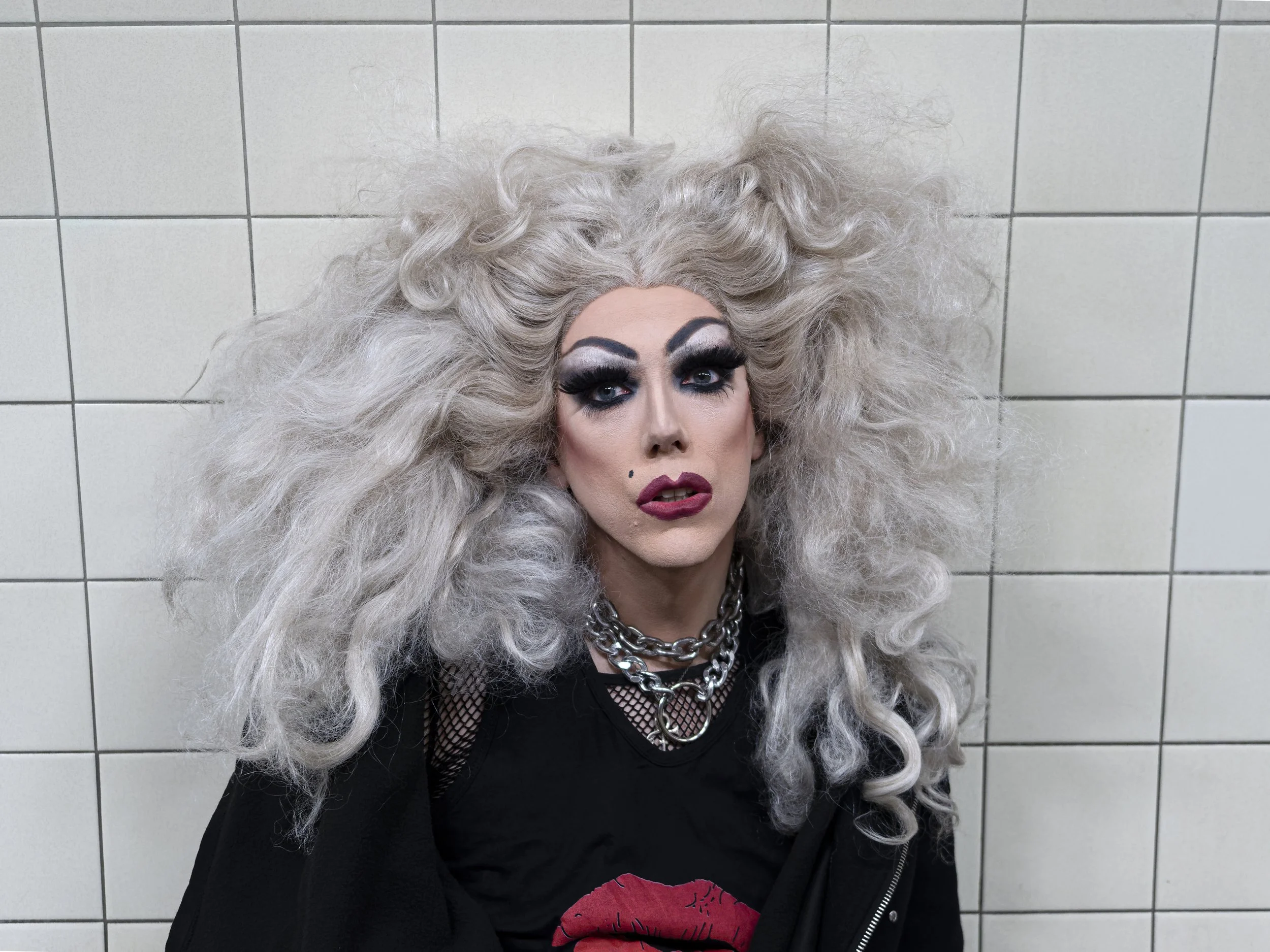

As told during my MA years, to nullify the need of words the photograph, if used to document, ought to be objective. The other/entity has to be looked at impartially, and in oder to do that, we all need to step out of our own cultural, linguistics, ideological biases systems of belief and preconceptions. If only for a few seconds, when you look at these images, be present by becoming other—and discover for yourself what paths might lead you toward happiness.
Some may conclude that recourse to appearance constitutes a peripheral form of happiness, and that depth ought to be sought far more specifically. Yet just as some choose to dwell within a perpetual carnival, others employ whatever is at hand—appearance included—to feel less pain, not more. For me, photography has been a means of feeling less pain; it has filled the vacuum left by, ignorance, arrogance, vulgarity and discrimination. These images never sought to negate subjectivity. Rather, they hold space for it—trusting that one day it will flourish anew upon the fertile ground once cultivated by biological intelligentsia.